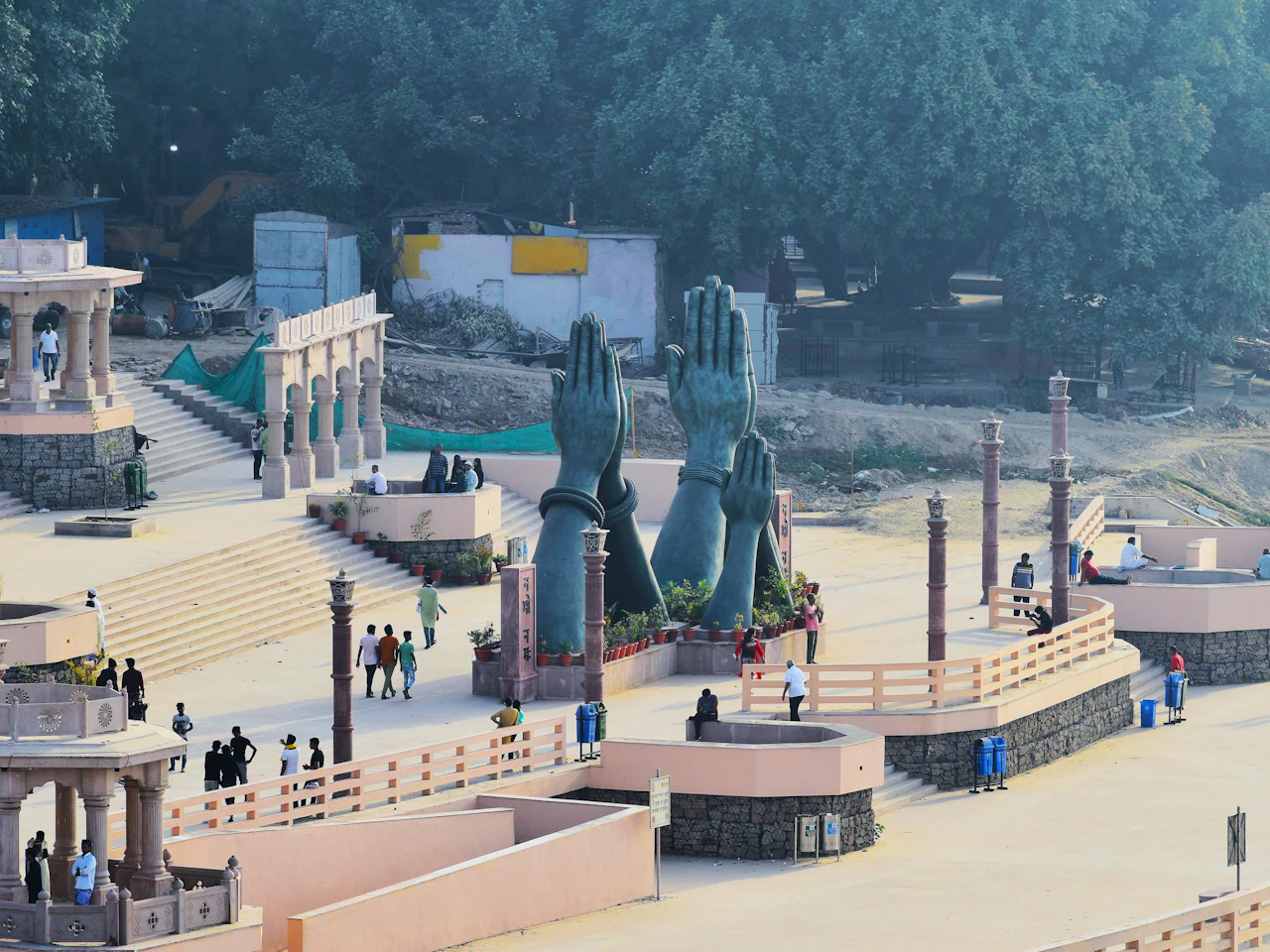
Every city eventually builds a room for its future, and Kashi — three thousand years old and unbothered by trends — built hers at the northern bend of the river. Namo Ghat is the city’s newest doorway: the old Khidkiya Ghat (“the window ghat,” where the city once peeped out at the river), reborn in phases between 2021 and 2023 as a vast, open riverfront plaza unlike anything else on the seven-kilometre crescent.
The hands you’ve already seen
You know the sculpture before you arrive — it has conquered every Varanasi reel and railway-station hoarding. Three colossal pranam hands rise from the plaza, palms joined in namaskar to the sky, bangles and all, in weathered bronze-green. The gesture names the place: namo — “I bow.” Locals will offer you three readings, all correct — the city greeting the Ganga, the Ganga greeting the pilgrim, and Kashi folding its hands to Mahadev, whose city this has always been. Stand under them at sunrise, when the mist comes off the water and the first light catches the fingertips, and the newest ghat in Banaras manages the oldest trick in Banaras: it makes you go quiet.
What the new ghat does differently
Namo Ghat is everything the ancient ghats gloriously are not: spacious, step-free and organised. A long ramp runs gently down to the water — the first time in the city’s history that a wheelchair, a pram or an elderly pilgrim’s knees can reach the Ganga without battling stone steps. There’s a food court (chaat to thalis, evening crowds treating it like a mela), an open-air theatre that hosts everything from classical concerts to laser shows, a floating CNG station serving the city’s green-converted boats, jetty berths for the river cruises, a helipad, and — believe it when you see it — actual parking. During Dev Deepawali, Namo Ghat’s wide terraces fill with diyas and light-shows, and its breathing room makes it one of the saner places to witness the spectacle.
How it fits your yatra
Treat Namo Ghat as a counterpoint, not a substitute. Come here for arrival-day ease, sunset with the family, or a cruise departure — then go meet the old city: Panchganga’s saints and sky-lamps a boat-ride upstream, Dashashwamedh’s fire-lit evenings, the slow chai mornings of Assi. The fierce Kaal Bhairav, kotwal of the city, holds his court a short ride inland — pay your respects on the way in, as tradition asks. One city, two registers: the ghats where Kashi remembers, and the ghat where Kashi waves hello. Both, in their own way, fold their hands.