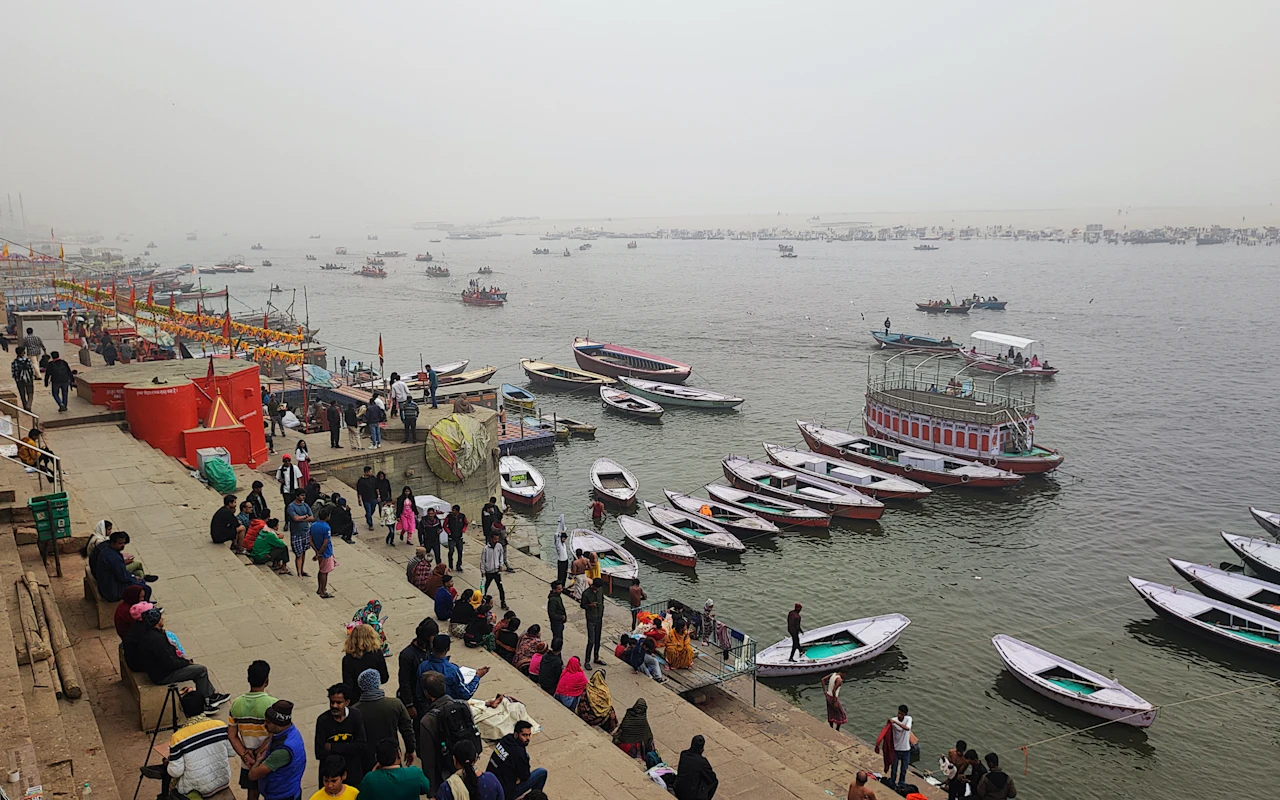
Most spectacles grow by getting bigger. Banaras’s most beloved leela has stayed exactly the same size for four centuries: one tree, one boy, one river, one serpent — and a city holding its breath. Nag Nathaiya, staged at Tulsi Ghat on Kartik Shukla Chaturthi (a few days after Diwali — around 13 November in 2026, but confirm with the panchang or any Banarasi), re-enacts in living theatre the Bhagavata Purana’s most cinematic episode: Krishna’s taming of the serpent-king Kaliya.
The story being told
In Vrindavan, the boy Krishna and his friends were playing ball on the banks of the Yamuna when the ball fell into a stretch of river poisoned by Kaliya, the hundred-hooded naga whose venom had blackened the water and killed the trees on the banks. Krishna climbed the lone surviving kadamb tree and dove in. What followed terrified the cowherds — the river boiling, the serpent’s coils around the child — until Krishna rose dancing on Kaliya’s hoods, weightless, beating time on the serpent’s heads until the naga surrendered and was exiled, the river running sweet again. It is the oldest Indian story about a poisoned river being healed — which gives its annual staging on the Ganga a quietly contemporary ache.
Four centuries of one leap
The leela was instituted by Goswami Tulsidas himself in the late sixteenth century, part of the great cycle of public theatre he gave the city (the Ramnagar Ram Leela across the river is its mightier sibling). The staging has barely changed. A kadamb branch is fixed leaning over the Ganga at Tulsi Ghat. At the auspicious hour — late afternoon, four-ish — a boy chosen to play Krishna climbs it, the crowd’s roar drops to a hush, and he leaps into the November-cold river, surfacing astride a great effigy of Kaliya, standing on the serpent’s hood with flute raised while conches blast, the crowd erupts into “Har Har Mahadev” and “Krishna Bhagwan ki jai,” and the Kashi Naresh — the Maharaja of Banaras — watches from his boat, as his ancestors have since the leela began. The whole divine drama takes minutes. Nobody complains about the running time.
Watching it well
The crowd is enormous for so small a stage — the steps of Tulsi Ghat and every neighbouring rooftop fill by mid-afternoon, and hundreds of boats raft together on the water for the best sightline (book one from Assi Ghat that morning; it’s a short row). Arrive by 2:30 pm, earlier for the front steps. The light is perfect — low golden November sun on the water — and photography is welcome, a relief after the city’s more solemn rituals. Pair the day with the southern temple loop in the morning, and chai on Assi afterwards while the boats disperse and half of Banaras walks home re-telling a story every single one of them already knew.