खाना
The Banarasi Food Guide
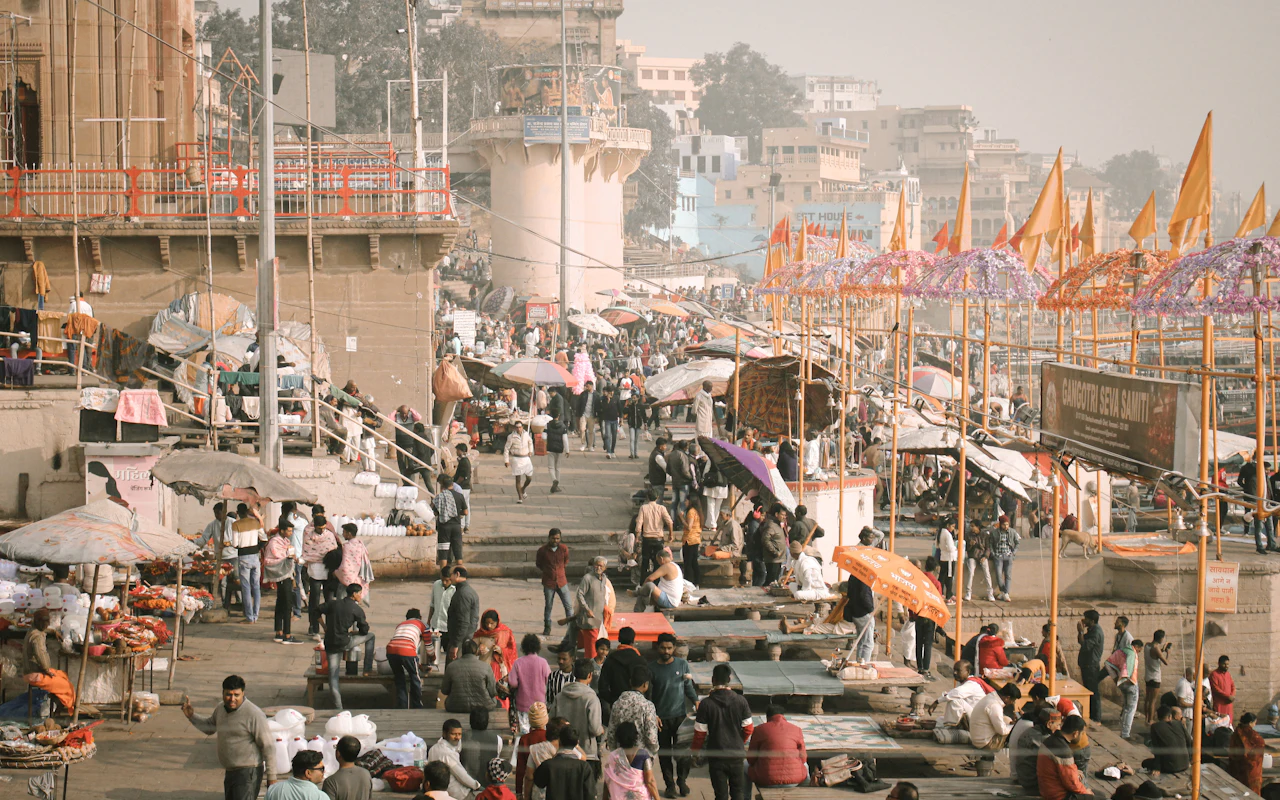
This is Annapurna's city — the goddess of food herself keeps house here, and Banaras treats eating as a devotional practice with excellent production values. Six things you must eat, where the locals actually eat them, and the etiquette of each.
Kachori-Sabzi
कचौड़ी-सब्ज़ीWhere: Ram Bhandar (Thatheri Bazaar), Kashi Chat Bhandar lane stalls, any shop near Vishwanath gali frying at 7 am
When: Breakfast, 6–10 am — the first batch from the kadhai is non-negotiable
Banaras does not believe in cereal. The city’s morning begins at a kadhai of bubbling ghee, where kachoris — wheat discs stuffed with spiced urad dal — puff into golden moons and are handed over in donas (leaf bowls) under a ladleful of aloo-tamatar sabzi: potatoes broken by hand, never cut, simmered with tomatoes, hing and a chilli content calibrated to wake the dead at Manikarnika. The small, flaky variant (khasta) arrives alongside, and the correct order is one of each.
Eat standing, elbow-to-elbow with rickshaw-wallahs and pandits — this is the city’s true common table. Then do as everyone around you does: walk three steps to the jalebi man and finish with a hot, sticky coil straight off the syrup. The whole transaction costs less than a postcard and explains Banaras better than any monument. Subah-e-Banaras is not just the aarti at Assi Ghat; it is also this — the city breaking its fast together at a hundred kadhais, arguing about politics with its mouth full.
Blue Lassi & Banarasi Lassi
बनारसी लस्सीWhere: Blue Lassi Shop (Kachori Gali, near Manikarnika), Pehelwan Lassi (Lanka), kulhad-wallahs across the old city
When: Midday and afternoon — the reward after a hot temple circuit
In a lane near Manikarnika Ghat, a shop the size of a wardrobe has been whipping curd since 1925. The walls are blue, and pasted with thousands of passport photos and notes from travellers — Japanese, Israeli, Brazilian — who found their way here, which is how the Blue Lassi Shop became the most internationally famous three square metres in Uttar Pradesh. The lassi arrives in a kulhad (single-use clay cup, the original biodegradable packaging), thick enough to require commitment, layered with malai, and topped — in the modern repertoire — with mango, pomegranate, banana or saffron-pistachio.
Purists may prefer the heavyweight tradition at Pehelwan Lassi near Lanka, where the wrestler-sized portions explain the name. Either way, the Banarasi lassi is not a drink but a meal with a point of view: dahi from full-cream milk, sugar with a generous hand, and the gentle earthiness the kulhad lends. When you finish, smash the kulhad in the clay-shard pile like a local — it returns to the earth, and the gesture is oddly satisfying after a morning among the eternal things.
Malaiyo
मलइयोWhere: Chowk, Thatheri Bazaar and Godowlia street vendors with the big clay handis — winter mornings only
When: November to February, dawn to mid-morning; it literally cannot exist in warm weather
Some dishes are seasonal; malaiyo is meteorological. On winter nights, vendors set wide clay handis of sweetened, saffron-tinted milk out on rooftops under the open sky — and the night dew (os, the old men insist, is the actual ingredient) works some colloid chemistry that no kitchen can replicate. Before dawn the milk is whipped until it becomes a pale-gold foam — not a liquid, not a solid, barely a substance at all — heaped into kulhads, dusted with pistachio and cardamom.
You eat it with a small wooden paddle, and the experience is of eating a sweet, saffron-scented cloud: it dissolves before your teeth find anything to do. By 10 am the foam collapses and the day’s stock is finished; by March the season is over entirely. Delhi calls its version daulat-ki-chaat and Lucknow makes nimish, but Banarasis are serenely certain theirs is supreme — the Ganga’s own winter mist, they’ll say, is the secret. If your trip is in Dev Deepawali season or later, set one alarm for the aarti and a second for malaiyo. Both are gone by mid-morning.
Baati Chokha
बाटी चोखाWhere: Baati Chokha restaurant (Teliyabagh), highway dhabas, and festival stalls at Ganga Mahotsav
When: Lunch or dinner; best in the cooler months when the coals are kindest
This is the dish that connects Banaras to its hinterland — the food of eastern UP and Bihar’s fields, promoted to city delicacy without losing its smoke. Baati: dense whole-wheat balls, traditionally roasted on cow-dung-cake embers (upla), cracked open while scalding and drowned in ghee. Chokha: brinjal, potatoes and tomatoes roasted directly in the same fire, peeled and mashed with mustard oil, raw onion, garlic, green chilli and salt — every element tasting of flame.
The combination is rustic, smoky, hugely satisfying, and the closest thing the region has to an edible flag; it’s what Bhojpuri labourers carried to railway colonies and Girmitiya ships, which is why versions surface from Mauritius to Suriname. In the city, the famous Teliyabagh restaurant serves it on leaf plates in deliberately village-style surroundings (litti, its Bihari sibling, also appears), and the stalls at Ganga Mahotsav roast theirs over open coals by the river. Eat it with both hands and a complete absence of cutlery-related dignity. The ghee will find your elbow. Let it.
Banarasi Paan
बनारसी पानWhere: Keshav Tambul Bhandar (Lanka), Chaurasia shops at Godowlia and Chowk — look for the busiest counter
When: After meals, after aarti, after anything — the Banarasi answer is 'now'
Amitabh Bachchan only confirmed in song what the city had known for centuries: khaike paan Banaras wala changes your operating system. The Banarasi paan is built on the maghai leaf from Bihar — small, pale, tender, with none of the fibrous chew of lesser leaves — aged carefully until it practically dissolves. Onto it go kattha and chuna (catechu and slaked lime), supari, gulkand (rose-petal jam), saunf, cardamom and the paanwala’s guarded personal touches; folded into a gilauri and pinned with a clove, it should melt — ghulna, locals insist, not chew.
The paan shop is Banaras’s true parliament: news, gossip, philosophy and cricket selection are all settled across the counter while the paanwala’s fingers fly. Order a meetha paan (sweet, safe, glorious) as your entry-level degree; the tobacco varieties are a different faculty and best left unexplored. Eat it after dinner, lean on something, and let the rose-and-clove perfume reorganise your evening. One etiquette note the city will thank you for: swallow or bin it — the red arcs on Kashi’s old walls are the one local tradition not worth joining. GI-tagged in 2023, the Banarasi paan now has the paperwork to prove what every adda always knew.
Thandai
ठंडाईWhere: Baba Thandai and the Godowlia thandai houses, Mishrambu (Chowk); landmark shops grind masala fresh per glass
When: Hot afternoons year-round; ritually on Mahashivratri and Holi
Thandai is what happens when a civilisation with forty-five-degree summers and world-class spice routes decides to engineer the perfect cold drink. Full-cream milk is poured over a paste ground fresh, per glass at the great Godowlia counters — almonds, melon seeds, fennel, rose petals, black pepper, cardamom, saffron — strained, chilled and handed over in a heavy brass tumbler or kulhad. It is rich, floral, faintly peppery, and more effective against the loo (the hot wind, that is) than any air-conditioner.
It is also, famously, the licensed vehicle for bhang — Shiva’s herb, ground into a green paste and available at government-authorised shops in the city. On Mahashivratri and Holi, bhang-thandai is practically a sacrament, consumed with devotional thoroughness by people who will spend the next six hours finding the word “Mahadev” unreasonably profound. Our honest advice sits in the yatra tips: if you try it, try a quarter of what the shopkeeper suggests, never before a boat ride, and never on a travel day. The plain (sada) thandai needs no caveats at all — it is simply the best thing that can happen to you at 3 pm in May, and the brass tumbler is non-negotiable tradition.
Eating well, eating safe
Banarasi street food has fed pilgrims for centuries and knows its business: pick stalls that are busy and frying fresh, eat hot things hot, prefer kulhad over glass, and let your stomach acclimatise for a day before the full syllabus. Most of the old city's classics are pure vegetarian — this is a temple town to its bones. Pair the food trail with the ghats it lives beside, and if your trip lands in winter, plan mornings around malaiyo and evenings around Dev Deepawali. Annapurna looks after the rest.