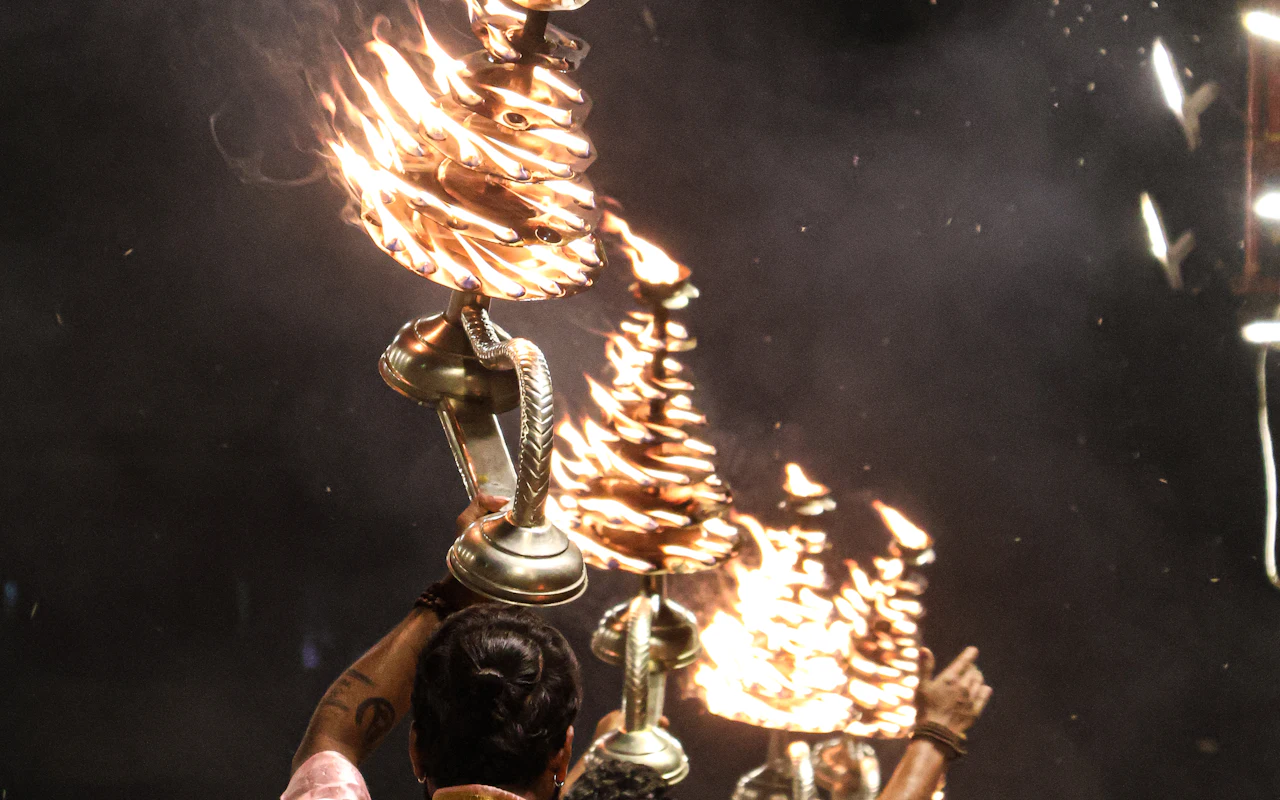
Mahashivratri is observed across the Hindu world — but observing it in Kashi is something else entirely, the difference between writing to someone and showing up at their house. This is, by every account the tradition keeps, Shiva’s own city: he never leaves it, not even (the Puranas insist) during cosmic dissolution. So on the Great Night of Shiva, Banaras is not commemorating a distant lord. It is throwing its landlord a birthday party.
The night of the wedding
Among the many stories attached to the night — the night Shiva danced the tandava, the night he swallowed the poison, the night a hunter’s accidental bilva-leaf offering earned him heaven — Banaras prefers the most domestic one: Mahashivratri is Shiva and Parvati’s wedding night. Accordingly, the city stages a full shiv baraat, a groom’s wedding procession, through the old streets: Shiva’s marriage party with its proper complement of ash-smeared sadhus, costumed bhoots and ganas, snake-charmers, bands playing wildly, and the general principle that the groom’s side of this particular wedding includes everyone unconventional in three worlds. It is riotous, hilarious and devout in the same breath — peak Banaras.
The serious devotional spine of the night is the jagran: devotees fast through the day and keep vigil through the four praharas (watches) of the night, with the linga bathed in milk, honey, gangajal and bilva leaves at each watch, and the air a continuous weave of Om Namah Shivaya and Har Har Mahadev.
Vishwanath on the great night
At Kashi Vishwanath, Mahashivratri is the heaviest day of the calendar: the queue can stretch several kilometres through the corridor and lanes, lakhs of pilgrims pass in twenty-four hours, and the sanctum stays open through the night (the date — 6 March in 2027 — follows the panchang; verify before booking). Strategy, from those who do it yearly: either join the queue well before dawn, or surrender to it as the experience itself — the line is the festival, chanting, sharing peanuts, swapping Shiva stories with strangers. The paid darshan tickets are usually suspended on this day; everyone queues alike, which is rather the theological point. The smaller shrines — Kedareshwar at Kedar Ghat, Kaal Bhairav, the linga at every corner — run their own packed, joyful schedules and are the wiser choice if crowds alarm you.
Practical notes
Bhang — Shiva’s herb — circulates freely on this night in thandai and golis; if you partake, do it knowingly, lightly, and never before a boat ride. February–March nights are pleasantly cool: a shawl, sturdy footwear for hours of standing, and a phone-free temple plan (lockers at the gates) are the kit. And at some point after midnight, step away from the crowds down to Manikarnika’s stretch of riverfront, where the fires burn as always, and consider that this — the city where death itself keeps vigil with the auspicious — is exactly what the night celebrates: the lord for whom ash and bridegroom’s turmeric are the same substance, Shivratri and Shiv-barat the same word half-turned.