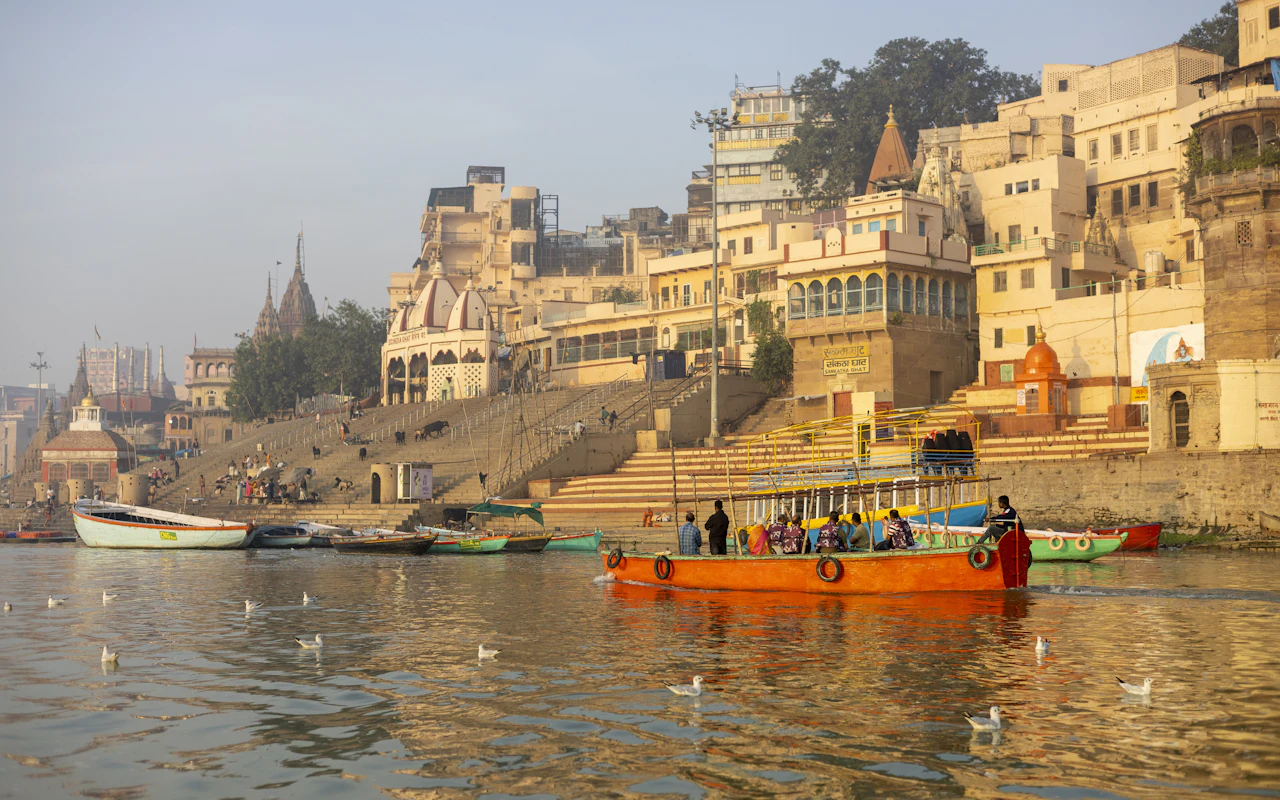
Everything else in this city is commentary; Vishwanath is the text. Kashi exists because Shiva, the tradition says, chose this patch of high ground above the Ganga as his permanent home — and the Kashi Vishwanath Mandir, one of the twelve Jyotirlingas where the lord blazed forth as a column of light, is the address itself. For a believing Hindu, darshan here, paired with a bath in the Ganga, is among the holiest acts a life can hold.
A temple that refused to die
The shrine’s biography reads like the subcontinent’s: built, razed, rebuilt, razed again — by invaders from Qutb-ud-din Aibak’s generals to Aurangzeb, who in 1669 demolished the standing temple and raised the Gyanvapi mosque on the spot. For a century the linga was worshipped in courtyards and memory. Then, in 1780, Ahilyabai Holkar, the saintly Maratha queen of Indore, built the present temple just beside the old site; in 1835 Maharaja Ranjit Singh of Punjab gilded its domes with roughly a tonne of gold, giving Banaras its “Golden Temple.” That a structure so modest in size carries so much weight is itself very Kashi: the city has never confused magnificence with holiness.
In 2021 the Kashi Vishwanath Dham corridor transformed the temple’s setting — the warren of lanes between sanctum and river opened into a broad processional of pale Chunar stone, so pilgrims now walk up directly from Lalita Ghat with gangajal in hand, the way the rite was always meant to flow. Whatever one thinks of old lanes lost, the experience of rising from the river to the Jyotirlinga in one unbroken movement is undeniably powerful.
How darshan actually works
Expect airport-grade security and no phones, no bags, no leather — lockers at the gates are quick and cheap, so travel light and carry photo ID. The free queue moves steadily on ordinary days; the paid sugam darshan ticket shortcuts it when time is short. Inside, the moment itself is brief — a silver-plated altar, the dark linga, a pandit calling aage badho — and somehow sufficient. Touching the linga requires traditional dress and usually the early hours; for most visitors, general darshan from the rail is the practical choice.
The classic sequence locals will urge on you: Vishwanath first, then Maa Annapurna next door — Shiva’s consort who feeds the city — and within a day or two, Kaal Bhairav, the city’s guardian, without whose acknowledgement a Kashi yatra is traditionally considered incomplete. On Mahashivratri the queue can run kilometres and the chanting runs all night; it is chaos, and many pilgrims would not trade it for any orderly heaven.