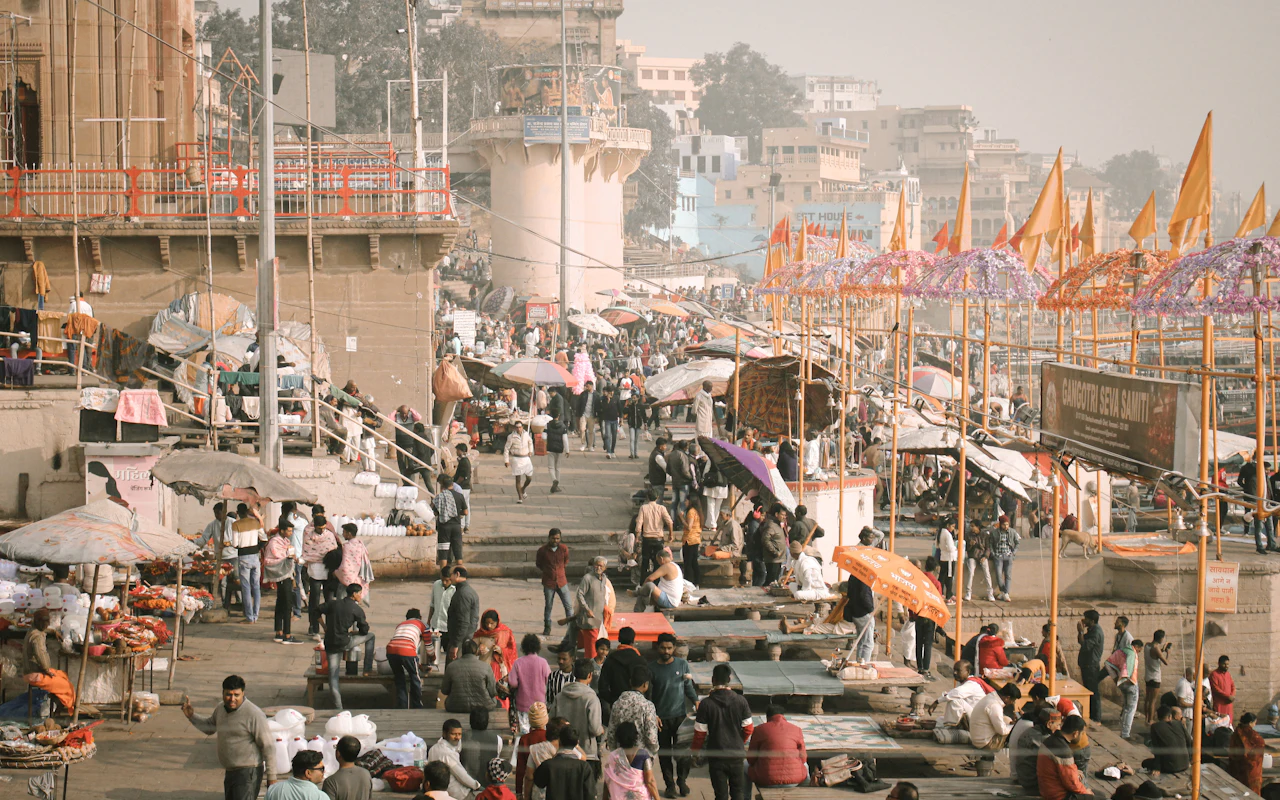
Of all the theological arrangements in Kashi, the loveliest is this: the Lord of the Universe lives here — and his food comes from his wife’s kitchen next door. The Annapurna Devi Mandir stands a few steps from Kashi Vishwanath, and in the city’s imagination she is not a minor consort shrine but the queen of Kashi, the goddess of nourishment without whom the lord of everything would go hungry. Anna is food; purna is fullness. Her name is a promise.
When Shiva held out a bowl
The story is told with relish in every Banarasi kitchen. Shiva, in a transcendental mood, declared the material world — food included — to be maya, illusion. Parvati, who has never lost an argument that mattered, simply withdrew. As the goddess of all sustenance, her absence meant the worlds went barren: no harvests, no meals, nothing. The gods starved; humanity wailed; even ascetic Shiva discovered that transcendence runs on calories. Parvati then reappeared in Kashi, serving food to all — and Shiva himself came to her, begging bowl in hand, to ask for alms. She fed him with her own ladle, and the moment is the temple’s central image: the supreme renunciant acknowledging that the kitchen, too, is God. Shiva, in gratitude, granted that no one who dwells in Kashi shall sleep hungry — and named her co-sovereign of the city.
The kitchen that never closes
The present temple was raised in the 18th century by the Maratha Peshwa Baji Rao I, in the dense gold-smelling lanes of the Vishwanath quarter. Its most important architecture, though, is institutional: the annakshetra, the free kitchen that feeds hundreds daily — pilgrims, widows, the poor, anyone — making the theology operational every single afternoon. Donating here (grain, ghee, funds) is considered among the most direct forms of punya the city offers.
The everyday murti of Annapurna holds her ladle and vessel in serene silver-black; but once a year, around Annakut (the day after Diwali), the temple unveils its golden Annapurna — a solid-gold image shown for a single day, with Shiva’s begging form before her — and half the city queues through the night for the darshan. In 2021 the temple also received home a beautiful 18th-century Annapurna idol repatriated from a Canadian museum, a small act of the goddess gathering her things back.
Do as pilgrims have always done: Vishwanath first, Annapurna immediately after — the lord, then the lunch. Then walk down to Dashashwamedh and let the khana of Banaras continue the goddess’s argument in practical form.