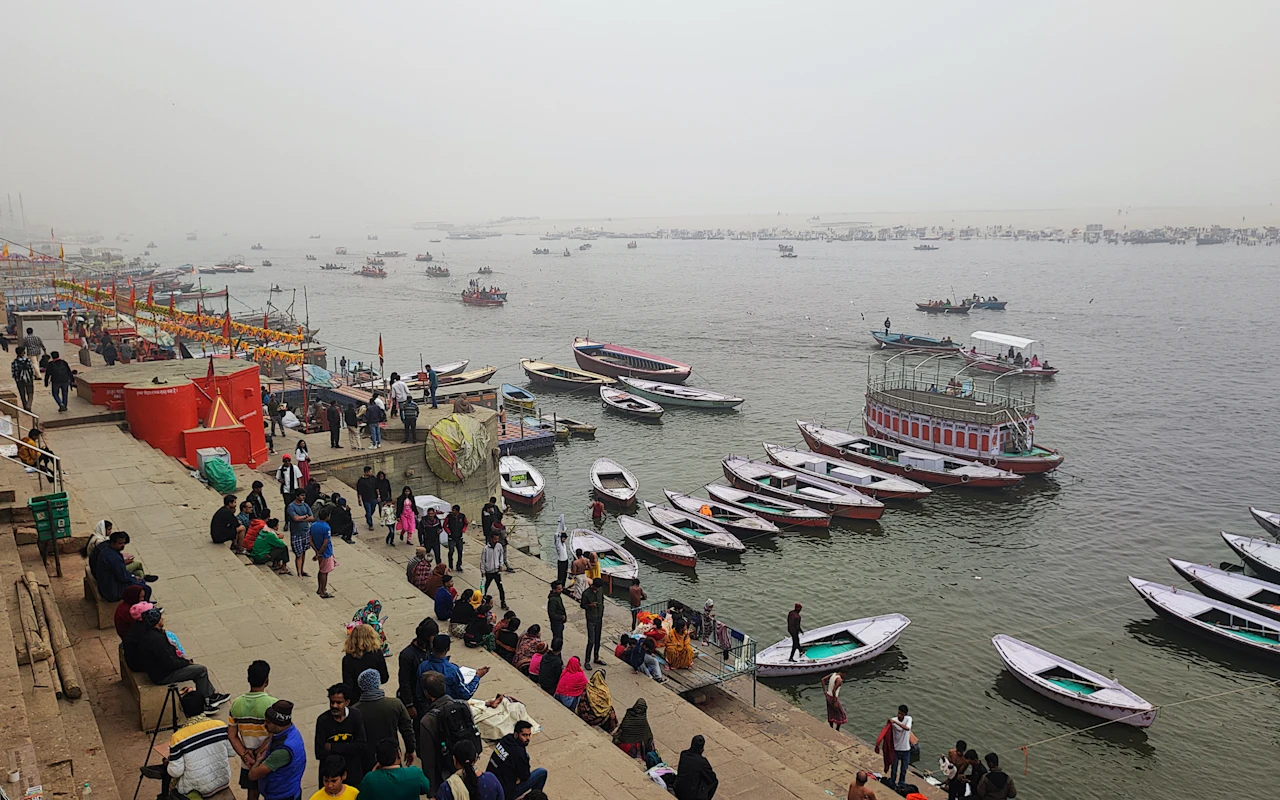
You will know Kedar Ghat before anyone tells you its name. From the river it announces itself in broad strokes of red-ochre and white — the candy-striped stairway and temple walls painted in the South Indian temple fashion, rising from the water like a flag planted by the Deccan in the middle of Uttar Pradesh. This is the most South Indian corner of Kashi, and one of its most quietly joyful.
Kashi’s own Kedarnath
The Kedareshwar Mahadev temple above the steps holds a swayambhu linga — self-manifested, not installed by human hands — with a rough, riven surface unlike any polished linga you’ve seen. The legend: a devoted but poor Brahmin named Vasishtha, who longed to make the pilgrimage to Kedarnath in the Himalayas, was too old and frail for the climb. Moved by his decades of devotion, Shiva appeared here as Kedarnath, splitting through a plate of khichdi the old man had offered — which is why the linga’s surface looks the way it does, and why khichdi is still offered here. The Kashi Khand goes a step further and declares that darshan at this Kedareshwar carries merit equal to — some pandits will say sevenfold — the Himalayan shrine. Kashi, generous as ever, brings the mountains to the river.
The temple is the centre of the Kedar Khand, the southern of the three traditional divisions of the sacred city, each named for its presiding linga. Bengali, Tamil and Telugu families have settled this mohalla for generations, and you’ll hear all three languages on the steps at dawn, mixed with Bhojpuri and the slap of wet dhotis on stone.
Mornings on the steps
Kedar is, above all, a bathing ghat — among the most devout on the entire riverfront. Come between half past five and eight and the steps are a complete civilisation: sankalp-taking pilgrims, brass lotas catching the sun, a priest stamping sandalwood tridents on foreheads, grandmothers descending the steep steps with the courage of paratroopers. Beside the temple is the small Gauri Kund, whose waters are held to be healing. The ghat’s steps are steeper than most — that strange Banarasi steepness that makes every descent a small act of faith — so take them slowly.
During Shravan and on Mahashivratri, the queue for Kedareshwar winds far down the steps, with chants of Har Har Mahadev rolling over the water. On ordinary days, though, this stretch is calmer than Dashashwamedh — a fine place to sit with chai and watch the boats slide past toward Harishchandra just downstream.