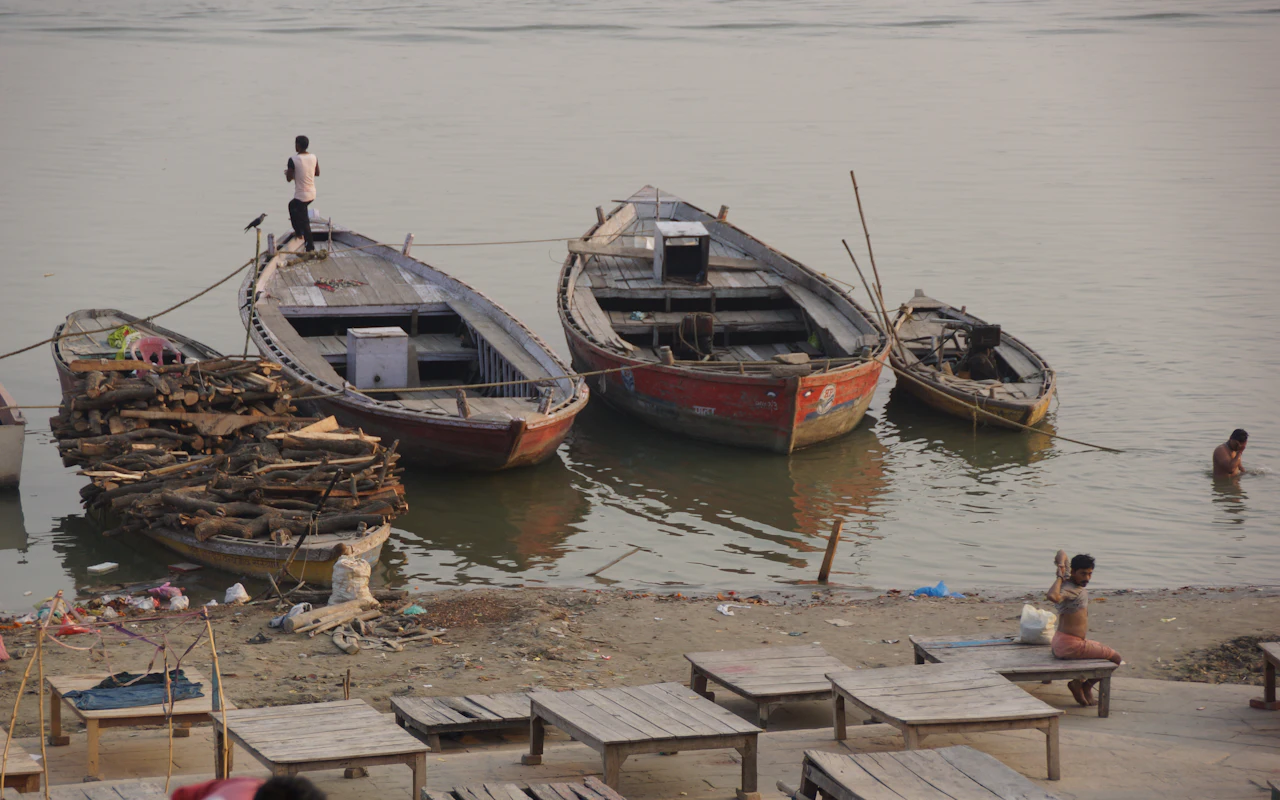
Two fires burn eternally in Kashi, and the older story belongs to the smaller flame. Harishchandra Ghat, on the southern sweep of the riverfront between Kedar and Assi, is the city’s second cremation ground — less thronged than Manikarnika, and carrying a legend that every Indian child once knew by heart.
The king who would not lie
Raja Harishchandra of Ayodhya was famed for never speaking an untruth. The sage Vishwamitra, determined to find the crack in this perfection, extracted a promise that cost the king his kingdom, then his wealth, then — through a relentless cascade of dharma-bound obligations — his wife and son, and finally his own freedom. Harishchandra ended up here, on this very riverbank, sold as a servant to the keeper of the cremation ground, collecting the tax on shrouds.
The test reached its unbearable peak when his own wife arrived at the ghat carrying the body of their son, dead of snakebite, with no coin to pay the cremation fee. And the king — destitute, unrecognised, breaking inside — still would not waive the tax, because it was not his to waive. Truth held. The gods relented. Son restored, kingdom returned, and the king’s name fixed forever to this ghat as a synonym for satya itself. Gandhi wrote that watching a play of Harishchandra as a boy set the course of his own devotion to truth. When Hindi cinema began, its first feature film — Raja Harishchandra, 1913 — chose the same story. This modest ghat sits at the headwaters of both.
The quieter mahashamshan
Many families, particularly from the southern districts, prefer Harishchandra for last rites; some hold it to be even older than Manikarnika as a cremation site. An electric crematorium was added in the 1980s alongside the traditional wood pyres. The same etiquette applies as at Manikarnika: no photography of the pyres, sober dress, quiet voice, upper steps. The fires here are fewer and the atmosphere more intimate — which, if anything, asks for greater care from the visitor.
Around the ghat
The surrounding mohalla is wonderfully workaday Banaras — sari weavers, akhada wrestlers, a famous old shop or two selling malaiyo in winter. Walk ten minutes south and you are at Assi’s cafés; ten minutes north brings the lake-like calm of Kedar Ghat with its candy-striped temple. The contrast is the lesson: in Kashi, the road between death and a hot kachori is never more than a few hundred steps, and nobody here finds that strange. Spend an evening on this stretch and neither will you.