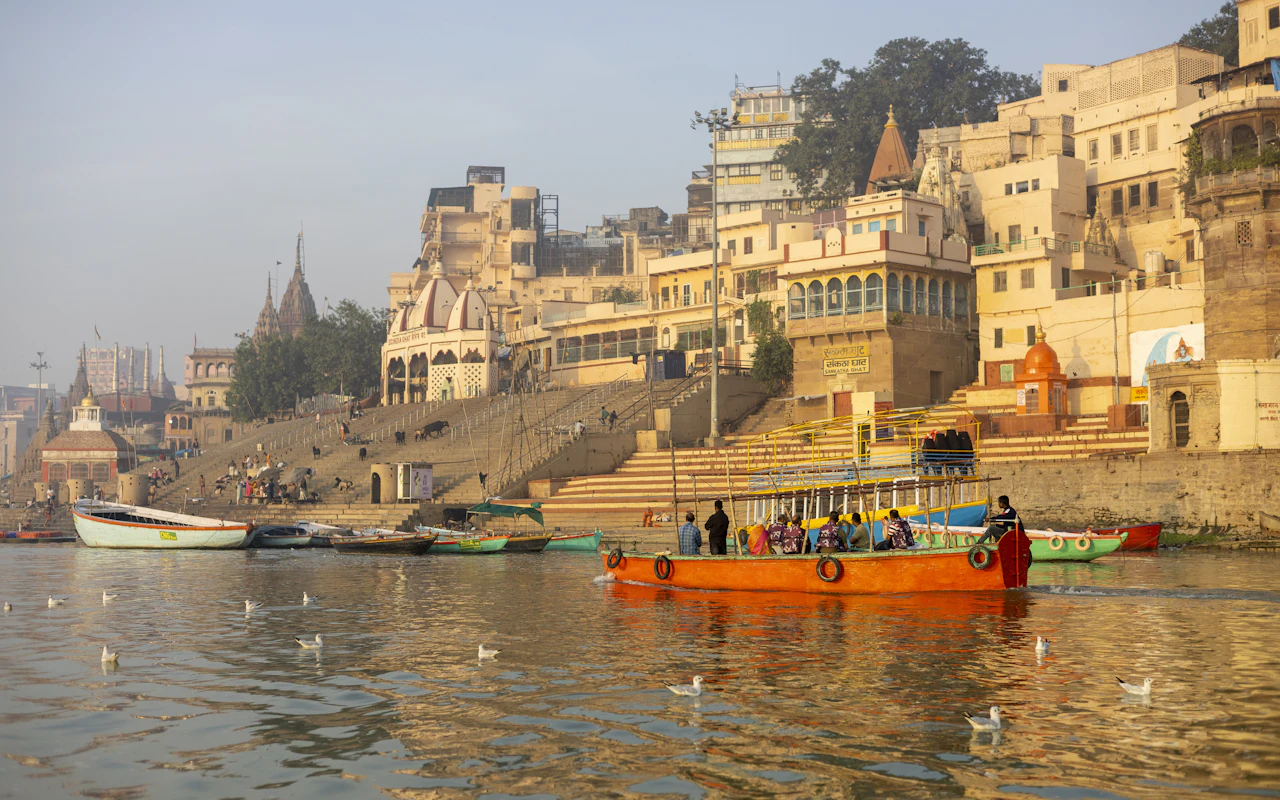
Every visitor’s camera roll from Varanasi contains one particular temple: a graceful stone shikhara at the water’s edge, leaning like a tired pilgrim, its lower half drowned in the Ganga for most of the year. That is Ratneshwar Mahadev — and the ghat it adorns, just north of Manikarnika, is Scindia Ghat, one of the most quietly beautiful stretches of the riverfront.
The temple that bowed to the river
The ghat was rebuilt grandly around 1830 by the Scindias, the Maratha rulers of Gwalior — one more chapter in the great Maratha refounding of Kashi’s riverfront. But the new construction proved too heavy for the soft riverbank; part of it slumped, and the elegant little temple at the water’s edge settled backward at an angle of about nine degrees — more of a lean than Pisa manages — where it has remained, flooded to the neck each monsoon, emerging glistening each winter. Banarasis, who never met a fact they couldn’t improve into a story, offer a legend too: a servant (some say a son) built the temple to honour his mother and boasted that his debt to her was repaid — and the temple bowed low at once, declaring that a mother’s debt can never be repaid. Geology and dharma, both satisfied.
For photographers, this is the dawn shot of Kashi: the tilted spire, a passing rowboat, mist coming off the water. Winter, when the river drops, shows the temple at its tallest.
Where fire was born
Climb the steps and slip into the dense lattice of shrines behind — this little quarter, Siddha Kshetra, is held to be tremendously potent. Its centrepiece, the Vireshwar shrine, is celebrated as the birthplace of Agni, the Vedic god of fire — a lovely thing to contemplate a hundred metres from the eternal flames of Manikarnika. Childless couples have prayed to Vireshwar for sons since antiquity; the lanes around are a honeycomb of small temples where the praying never quite stops.
A pause between the loud chapters
Scindia’s pleasure is its in-betweenness. South of you, Manikarnika’s fires and intensity; north, Panchganga’s sky-lamps and saints’ history; behind, the lane that leads toward Kaal Bhairav, the city’s fierce kotwal. The ghat itself stays calm — a few bathers, chess players in the shade, the slap of laundry from the next ghat down. Sit on the upper steps for half an hour with the leaning temple below you, and you’ll understand the local genius for letting holiness and ordinariness share a bench. On Dev Deepawali evening, when every ledge here carries a diya and the tilted shikhara stands in a lake of flames, it is — there is no other word — uncanny.