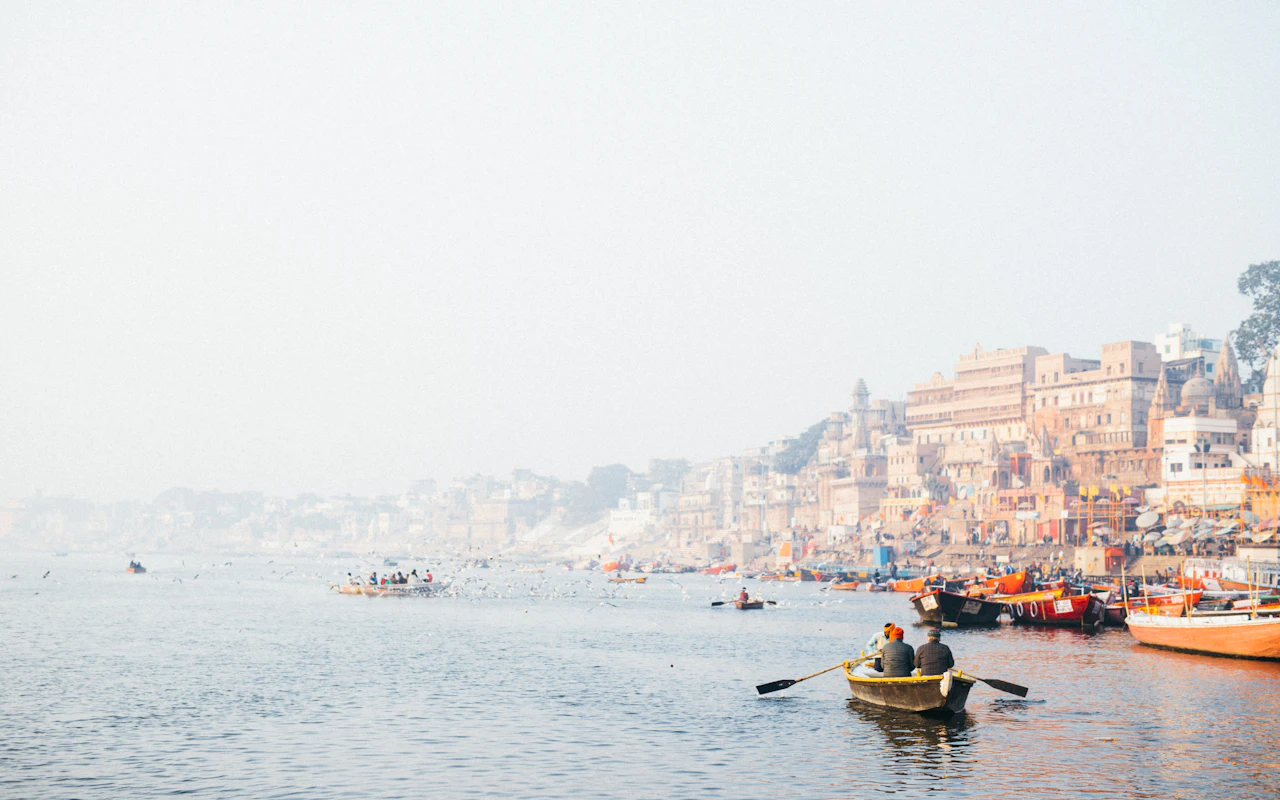
Some ghats whisper their history; Darbhanga declaims it from a colonnade. Walk south from Dashashwamedh and the riverfront suddenly goes full opera: a cliff of pale sandstone, ranks of tall Greek-style columns, domed chhatris and balconies stacked like a wedding cake — the most theatrical single facade on the entire six-kilometre sweep of the ghats.
Brahmin kings on the Ganga
The palace — locals call it Darbhanga Bhavan, and the name board may say Brijrama Palace — was raised in the early twentieth century by the Maharajas of Darbhanga, rulers of the vast Raj Darbhanga estate of Mithila in north Bihar. They were that rarity in princely India, a Brahmin royal house, among the subcontinent’s richest landowners and most lavish patrons of Sanskrit learning, music and the arts. Like every dynasty worth its salt, they wanted a foothold in Kashi — a place for ancestral rites, for retreat in the holy city, and, one suspects, for splendour. They bought an older Nagpur-built structure and rebuilt it to their taste, with stone hauled from Chunar, the same quarries that supplied Ashoka’s pillars two millennia earlier.
Look up at the columns and you’ll find the riverfront’s strangest architectural sentence: Greek capitals, Rajput brackets, a Shiva temple tucked into the terrace — colonial-classical grammar spoken with a thoroughly Banarasi accent. The Maharajas also left their name on Darbhanga colonies and institutions across the city; their musical court, incidentally, patronised the Dhrupad tradition, whose great annual mela still happens upstream at Tulsi Ghat each spring.
The palace’s second life
After decades of fading grandly — peeling shutters, nesting pigeons, photographers’ delight — the palace was restored as a luxury heritage hotel. You can’t wander its corridors without a booking (high tea is the traveller’s workaround), but its exterior belongs to everyone, and the restoration kept the facade honest. The ghat steps below remain entirely public and surprisingly quiet: laundry lines, a chess game, boys diving from the lowest step with maximum noise and minimum technique.
For your camera and your itinerary
Late afternoon is the hour — the western sun crosses the river and turns the colonnade to honey while the water goes molten behind you. From a boat, Darbhanga is the centrepiece of the classic facade sequence: Man Mandir’s carved balcony, then this colonnade, then the painted shrines running south toward Chet Singh’s battlements. On Dev Deepawali night the hotel and ghat are outlined in thousands of flames, and the palace finally gets the stage lighting its architects were clearly imagining all along.