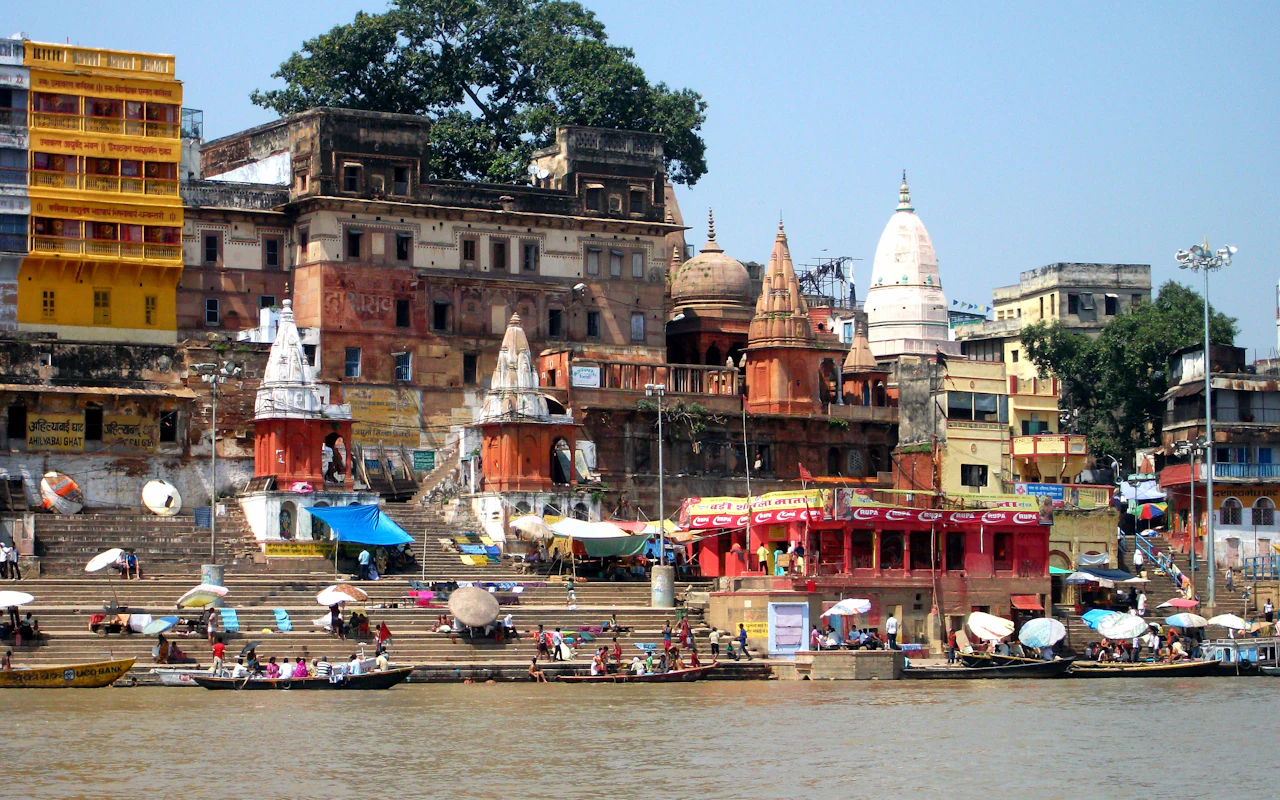
Kashi mostly looks inward and upward — toward moksha, toward Shiva. Man Mandir Ghat is the delicious exception: here the city looked up at the actual sky, with brass-edged instruments and Rajput precision. This is the ghat where astronomy moved in upstairs from the prayers.
A palace from Akbar’s court
The ghat takes its name from the palace that crowns it, built around 1600 by Raja Man Singh I of Amber — Akbar’s most trusted general and one of the great builders of his age. The palace is among the oldest surviving structures on the entire riverfront, and its northern stone balcony, carved with a density that makes lace look lazy, is routinely called the finest piece of secular architecture on the Ganga. From the river it gives the ghat its profile; from its windows, four centuries of royalty, pandits and houseguests have watched the same boats you’re watching.
The king who measured the heavens
In 1737, Man Singh’s descendant Sawai Jai Singh II of Jaipur — the astronomer-king who built the Jantar Mantars of Delhi and Jaipur — added an observatory to the palace roof. It is still there, and you can still climb to it: huge masonry instruments with poetry in their names — the Samrat Yantra, “emperor of instruments,” a great sundial accurate to minutes; the Nadi Valaya for the celestial equator; instruments for azimuth and altitude built from stone and lime, calibrated against the sky itself. The site is maintained by the Archaeological Survey of India (small ticket, daylight hours), and it is bafflingly uncrowded — you may share the roof with one caretaker and a kite or two. The view from the top, straight down the curve of the ghats with Dashashwamedh’s crowds to your left, is the best legal vantage point on the riverfront.
A small shrine of Someshwar — the Moon’s own Shiva — sits at the ghat, which feels apt: the lord of the moon at the foot of the stairway, the measurers of the moon at the top.
Visiting
Fold Man Mandir into your Dashashwamedh morning: dawn boat ride, breakfast kachori in the lanes, then the observatory as it opens, before the sun gets serious. The ghat below stays relatively serene, popular with sketchers and photographers framing the balcony. From here you can drift south past Darbhanga’s Greek columns toward Lalita Ghat — three architectural moods in three hundred metres, which is the riverfront’s whole magic trick: every kingdom of old India queued up here to build its own doorway to the river.